Membrane sourcing for Southeast Asian industrial water reuse: textile, electronics and municipal duty
For an Indonesian textile-dyeing reuse enquiry, an initial screen may consider ultrafiltration ahead of a fouling-tolerant brackish-water RO element, with nanofiltration considered where colour and divalent hardness matter more than total dissolved solids. That is a question set, not a selection. The foulant load, installed upstream train and site-specific reuse requirement decide what remains on the shortlist. Below are four regional duty patterns and the plant data required before a candidate is discussed.
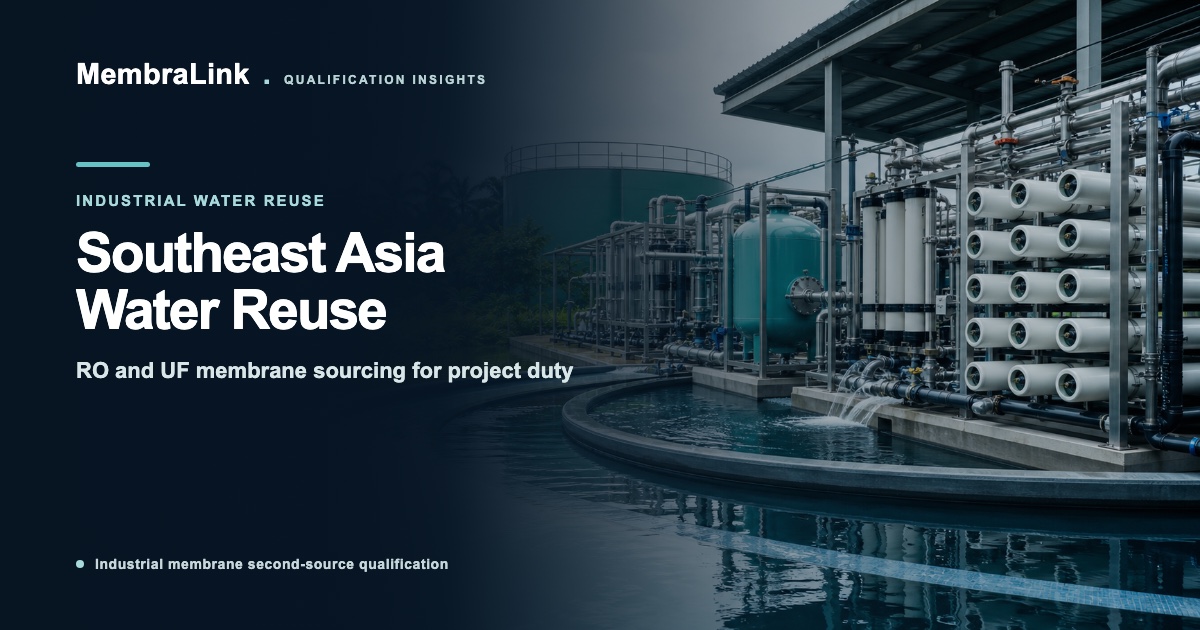
Why the reuse duty drives the selection of Southeast Asia industrial water reuse membranes
The element format tells you what will fit the vessel. The duty tells you what will survive in it. Almost every reuse enquiry opens with a format and a quantity, yet the two variables deciding the outcome sit upstream: what the feed carries, and what the plant already does to it before the first pressure vessel.
This matters more in reuse than in raw-water treatment. A brackish well is a reasonably stable feed; a dye-house or petrochemical effluent stream is a process by-product, so it moves with the production schedule, the chemical recipe and, in this region, the rainfall. An element specified against the average condition meets the peak condition eventually. A reuse enquiry is therefore scoped from operating history, not from a catalogue.
The four Southeast Asian duties buyers bring us
The four patterns below are a screening framework for common industrial and municipal reuse duties in the region. They are not a market-share claim and they do not state that one train is standard for every plant. The application duties MembraLink sources against are set out on the main site; the mapping below shows what evidence changes by duty.
Every row assumes the same standard reuse data set: full feed analysis, the existing upstream train, current cleaning frequency and chemistry, the recovery target, the discharge or reuse standard the plant is held to, the installed pressure-vessel and end-cap type, and the annual replacement volume. Column three lists only what that duty additionally needs.
| Regional duty | Dominant foulants and constraints | Membrane families typically screened | Additional plant data required | Open items normally flagged |
|---|---|---|---|---|
| Indonesian textile dyeing reuse and ZLD | Residual colour bodies and dye auxiliaries; high, variable organic load; sizing agents and surfactants; hardness and silica concentrating as recovery rises; temperature and pH swings between batch cycles. | UF for clarification ahead of RO; wide-spacer, fouling-tolerant brackish-water RO for the reuse stage; NF where colour and divalent hardness are the target rather than dissolved salts. | Whether dye-house effluent is segregated from utility streams; the batch cycle and its recipe range; where the ZLD boundary sits relative to the RO stage. | Industrial-estate discharge conditions and the concentrate route - to be confirmed against current destination rules. |
| Vietnamese electronics ultrapure water | Low bulk salt load but tight limits on organics, boron, silica and particles; a polishing duty in which trace breakthrough matters more than bulk load. | UF or MF as a particulate and colloid barrier; high-rejection brackish-water RO on the primary and polishing passes; NF rarely appropriate here. | The point-of-use specification and who sets it; whether degasification and polishing ion exchange sit downstream; the sanitisation regime the elements must tolerate. | Whether acceptance is governed by an internal fab specification or a customer audit - to be confirmed. |
| Thai petrochemical reuse | Hydrocarbon and oil-in-water carryover; organic load tracking unit turnarounds; biological growth in warm circuits; scaling from cooling-tower blowdown chemistry. | UF downstream of oil removal; wide-spacer, fouling-tolerant brackish-water RO for the reuse stage; NF for selective rejection and softening on blowdown. | Whether upstream oil removal is continuous or intermittent; blowdown chemistry and its residuals; turnaround windows constraining changeout. | Free-oil excursion limits at the membrane inlet and accountability for them - to be confirmed. |
| Philippine and Malaysian municipal MF+RO polishing | Raw quality varying with rainfall; biological fouling on secondary effluent; ammonia and residual disinfectant; iron and manganese in some sources. | MF or UF as the pretreatment barrier; fouling-tolerant brackish-water RO on secondary effluent; high-rejection brackish-water RO for the polishing stage. | Residual disinfectant control ahead of a polyamide element; wet- and dry-season feed range; new build or retrofit into existing vessels. | Whether the reuse standard is set nationally or by the water district, and its sampling point - to be confirmed against current destination rules. |
No performance figures are published on this page. Active area, salt rejection, permeate flow, operating pressure and boron rejection are issued only from the manufacturer's own datasheet, quoted with the manufacturer's stated test conditions, and confirmed per procurement against those conditions.
Two of these arrive as search phrases rather than briefs. An Indonesia textile wastewater reuse membrane enquiry is usually a mill that built the reuse loop and is now replacing elements more often than the business case assumed. Buyers looking for a Vietnam ultrapure water RO membrane supplier work to a fixed downstream specification and care more about consistency between batches than about the headline unit price. Each needs different questions put to the factory.
Where UF and NF belong in the train, and what each one changes downstream
Ultrafiltration and microfiltration as the barrier
In a reuse train, UF or MF can be designed as the particulate and colloidal barrier ahead of RO. Singapore PUB's official NEWater process is one documented example of MF or UF followed by RO and ultraviolet disinfection, not a universal design rule for another country or plant. The value of the barrier and its cleaning burden must be tested against the actual upstream treatment, feed variability and reuse target.
Nanofiltration as a selective stage
NF membrane wastewater reuse is specified where the objective is selective rather than total. Where the target is colour, organic load and divalent hardness, and monovalent salts can be tolerated in the recovered stream, NF does that work at lower operating pressure than a high-rejection RO stage and leaves a smaller concentrate problem. Where the reuse point needs low total dissolved solids, it does not. Settle the distinction early: it changes concentrate handling, the energy line in the operating budget and, in a ZLD scheme, the evaporation duty at the end of the train. ZLD membrane sourcing is a different exercise again - the membrane stages exist to shrink a volume, so selection follows the concentrate strategy.
Fouling-resistant elements: what a wide-spacer design buys you, and what it costs you
A request for a fouling resistant RO membrane 8040 should trigger a review of cleaning interval, differential-pressure trend, pretreatment performance and foulant history. Some brand owners describe wider-spacer or low-differential variants as intended to reduce colloidal-fouling effects. The dimensional and area trade is product-specific: it must be read from the exact manufacturer's data sheet rather than inferred from the words "wide spacer." The element families MembraLink screens are compared against the plant record on that basis.
Two constraints are consistently underweighted. A fouling-tolerant element answers a fouling load; it does not substitute for pretreatment, and if the UF stage is undersized or bypassed no element specification recovers the run length. The second is dimensional: fit is confirmed against your vessel drawing, brine-seal arrangement and end-cap type before quotation, and for a retrofit into vessels already holding a specific installed model the questions to be matched are set out in our RO membrane cross reference and replacement-selection guide.
Cleaning regime and run length: the operating data that must come from your plant
Run length is a property of the installation, not of the element, and it is the one figure a supplier cannot supply. We ask instead for the operating record: cleaning frequency now, the chemicals and sequence used, the differential-pressure trend that triggers a clean, how much condition each clean recovers, and how the interval has moved over the last two replacement cycles. That record tells a manufacturer more about the duty than a feed analysis alone.
The applicable reuse or discharge requirement must be identified for the specific country, locality, industrial estate, permit and sampling point. This page does not state which rule governs a buyer's plant. The requirement remains pending until the buyer or local adviser provides the current text and the responsible authority is identified. The same discipline applies to the factory side of the file, on the route set out in our checklist for qualifying a Chinese RO membrane manufacturer.
Import, conformity and vendor-registration requirements depend on product classification, intended use, the buyer's own specification and the current rules of the destination market, and they change. Any requirement described here is indicative only and must be confirmed against the current rules of the destination authority, the applicable conformity-assessment body and the awarding buyer for your specific project.
Regional evidence boundary: plant data before market-size estimates
This guide does not use a regional market-size number to predict an industrial buyer's membrane demand. Exact figures considered during drafting were removed because direct report pages supporting them could not be verified on 24 August 2026. Consumer water-treatment estimates are also a weak proxy for industrial replacement demand.
The sources retained below establish process context, not sales volume: the US EPA water-reuse guidance, the IFC textile-manufacturing guidance, Singapore PUB's published NEWater train and brand-owner membrane pages. A commercial programme still starts from the buyer's installed base, replacement history, feed analysis, cleaning record and approved budget. EPC teams can frame those inputs through the project-sourcing route. If a reuse project is being scoped now, send your requirement to the sourcing desk with the duty, the feed analysis and the cleaning history.
Sources and verification notes
These references were reviewed on 24 August 2026. They illustrate process and evidence requirements. They do not prescribe a train for a specific plant, prove destination compliance or establish equivalence between membrane products.
- US EPA Guidelines for Water Reuse: official reuse guidance and treatment-train context.
- IFC Environmental, Health, and Safety Guidelines for Textile Manufacturing: source segregation, wastewater variability and treatment options for textile facilities.
- Singapore PUB NEWater process: an official documented example of MF or UF, RO and ultraviolet disinfection in a reuse train.
- DuPont industrial wastewater reuse and DuPont nanofiltration overview: manufacturer application context, not independent performance evidence.
- Hydranautics ESPA product family and Hydranautics element specification sheets: maker-stated LD variants, dimensions, area and test conditions.